History
Chess is one of the oldest and most studied games in human history — with records dating back to the 6th century in India. Over centuries, it spread through Persia, the Arab world, and Europe, becoming the universal symbol of strategic thinking. World championships, AI analyses, and a global community of millions keep chess at the center of intellectual culture to this day.
In this digital version, you face an AI that plays with increasing depth based on difficulty — from random on Easy to a Minimax with 3-level search on Hard. Your white pieces drag across the board with intuitive movement, and the board automatically highlights all legal moves available on each turn.
Mechanics
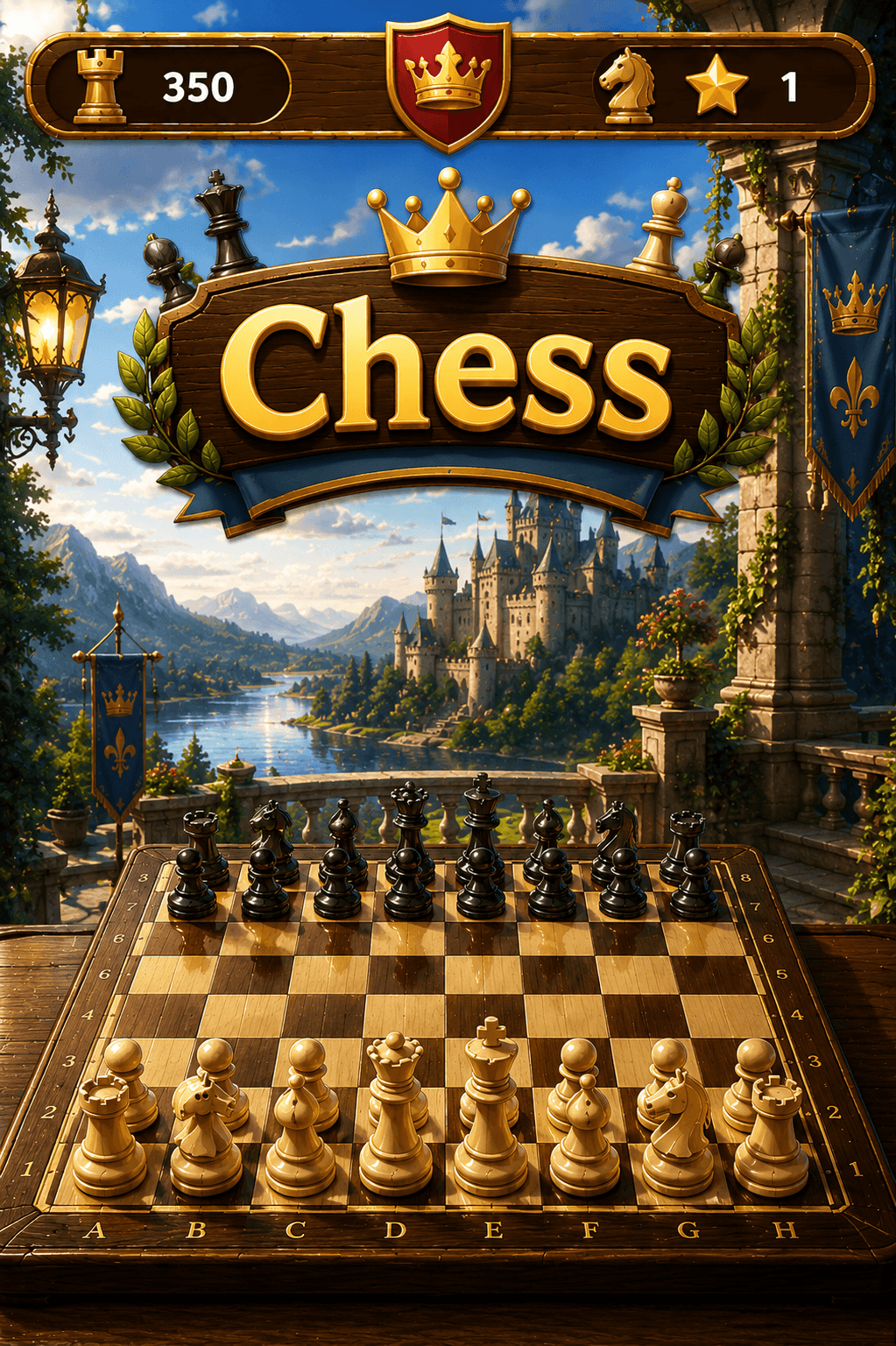
The game is played on an 8×8 board alternating light and dark squares. You control the white pieces and always go first. To move, drag a piece or click it — valid destinations are highlighted on screen.
Each piece type has a unique movement: the Pawn advances and captures diagonally; the Knight jumps in an "L" shape over other pieces; the Bishop slides along diagonals; the Rook travels in straight lines; the Queen combines Rook and Bishop; the King moves one square in any direction.
Special rules included: castling (kingside and queenside), en passant, and automatic pawn promotion to Queen upon reaching the last rank. The game ends in checkmate (king trapped with no escape) or stalemate (no legal moves but not in check).
Challenges
Chess's greatest challenge is thinking several moves ahead while adapting to the opponent's play. Every decision opens some possibilities and closes others — a poorly placed piece can be captured in sequence or block your own defense.
On Hard mode, the AI evaluates 3 levels of depth with alpha-beta pruning and piece-square tables, making it a consistent and strategic opponent. It prioritizes advantageous captures, protects its pieces, and systematically works toward checkmate. Beating it requires mastering opening, middlegame, and endgame.
Tips to Win
- 1Control the center: pieces on e4, d4, e5, d5 have more mobility and more influence on the game.
- 2Develop knights and bishops before moving the queen — developed pieces coordinate stronger attacks.
- 3Castle early to protect the king and connect the rooks.
- 4Don't trade pieces without strategic reason: each trade should improve your position or worsen the opponent's.
- 5Look for double threats — simultaneous attacks on two pieces guarantee at least one capture without reply.