History
In 1869, Russian chemist Dmitri Mendeleev had a bold vision: to organize all known chemical elements into a table that would reveal hidden patterns in nature. He did not merely list the 63 elements of his time — he predicted the existence of elements yet to be discovered, leaving blank spaces in his table. When those elements were found, their properties matched his predictions exactly.
Today, the Periodic Table has 118 elements — from hydrogen (the lightest and most abundant in the universe) to oganesson (artificially synthesized in a laboratory). Each element is a unique piece of the matter puzzle, with properties that reveal how the universe is built, atom by atom.
Mechanics
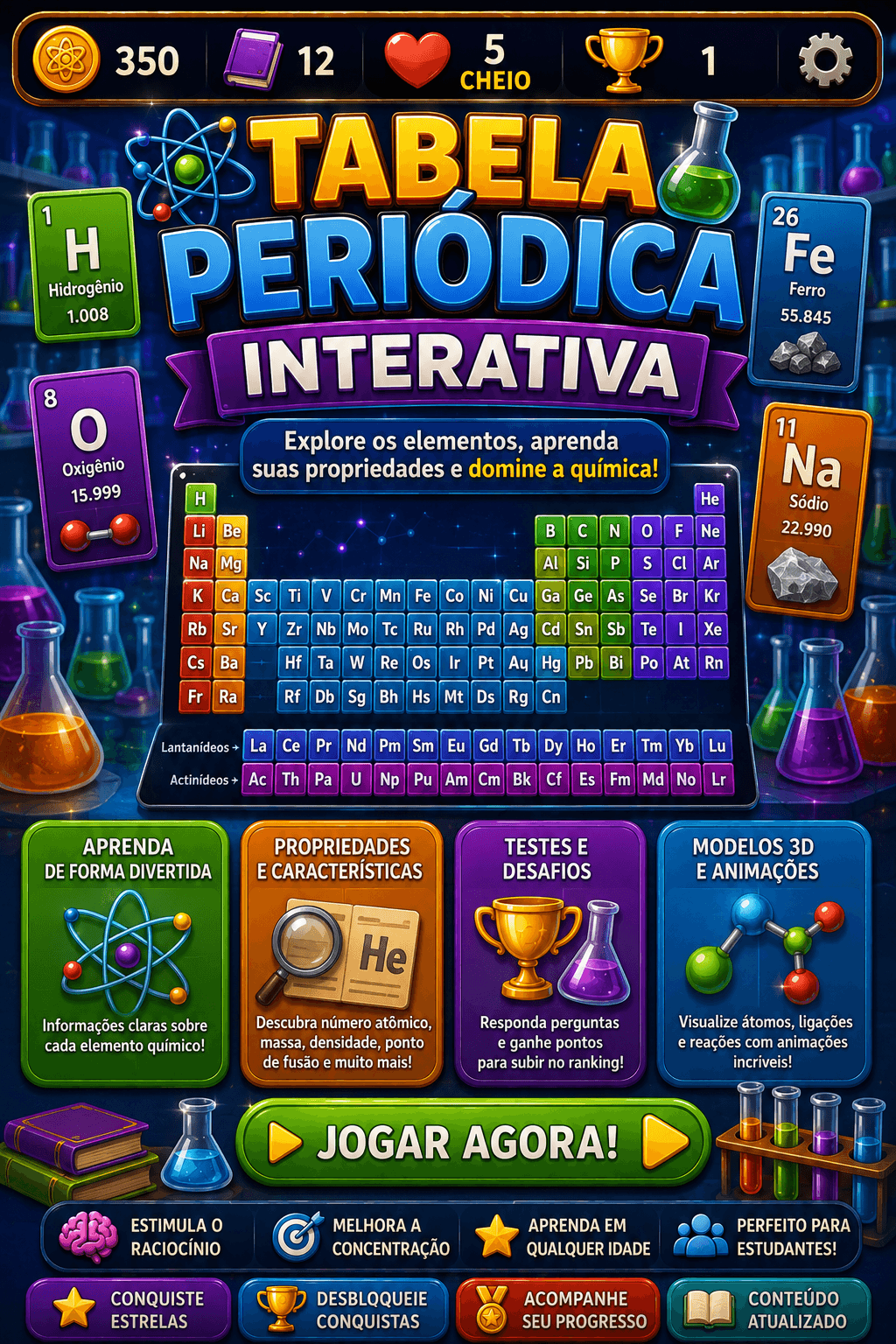
The Interactive Periodic Table offers four exploration modes. In Learn mode, the full table is displayed with filtering by category (alkali metals, noble gases, transition metals and more) and search by name or symbol. Tapping any element opens its detail panel showing atomic number, mass, physical state, period, group, and a scientific curiosity.
In Challenge mode, multiple-choice questions test your knowledge: identifying elements by name, symbol, atomic number, category, or physical state. A progressive hint system helps when you get it wrong — 2 mistakes reveal the period, 3 the group, 4 the position in the table. There are 4 difficulty levels that increase the number of questions and reduce available hints.
In Time Attack mode, a timed progress bar adds pressure to every question. In Daily Mission mode, 5 themed missions offer bonus XP for completing them every day. An XP system with 8 achievements tracks your journey.
Challenges
The greatest challenge is scale: 118 elements with different names, symbols, atomic numbers, categories, periods, and groups. Transition elements and rare earths form neighboring groups with similar properties, making it easy to confuse symbol "Mo" (Molybdenum) with "Mn" (Manganese), or "Ce" (Cerium) with "Cs" (Caesium).
In Challenge mode, questions about physical states require knowing that most metals are solid at room temperature, but exceptions like Gallium and Mercury are liquid — and it is precisely those exceptions that the hardest questions target. Mastering the lanthanides (La-Lu) and actinides (Ac-Lr) — 30 rarely studied elements — is what separates average scores from the highest.
Tips to Win
- 1Start with Learn mode and explore categories one by one — filtering by "alkali metals" or "noble gases" lets you learn each family's patterns before being tested.
- 2One or two-letter symbols almost always come from the Latin or German name: Fe = Ferrum (iron), Au = Aurum (gold), W = Wolfram (tungsten) — learning these origins helps with memorization.
- 3In Challenges, use hints strategically: period and group together locate the element on the table precisely — combine both to deduce the element even without knowing the name.
- 4Watch out for physical state exceptions: mercury (Hg) is the only metal liquid at room temperature; bromine (Br) is the only liquid non-metal. These facts appear frequently in questions.
- 5Complete the Daily Missions every day — beyond bonus XP, they present elements from varied categories, accelerating your learning of the complete table.