History
The Great Image Museum housed the most beautiful portraits in the world — exotic animals, fantastic landscapes, magical creatures and scenes from nature. But one day, a mysterious gust of wind invaded the museum and shattered every painting, scattering each piece to the four corners of the place.
You have been summoned as the Image Restorer — the only one capable of gathering each fragment and rebuilding the works of art. With patience, attention and sharp spatial perception, you will assemble piece by piece, returning the museum to its original beauty. The more pieces you fit together, the more incredible details will be revealed.
Mechanics
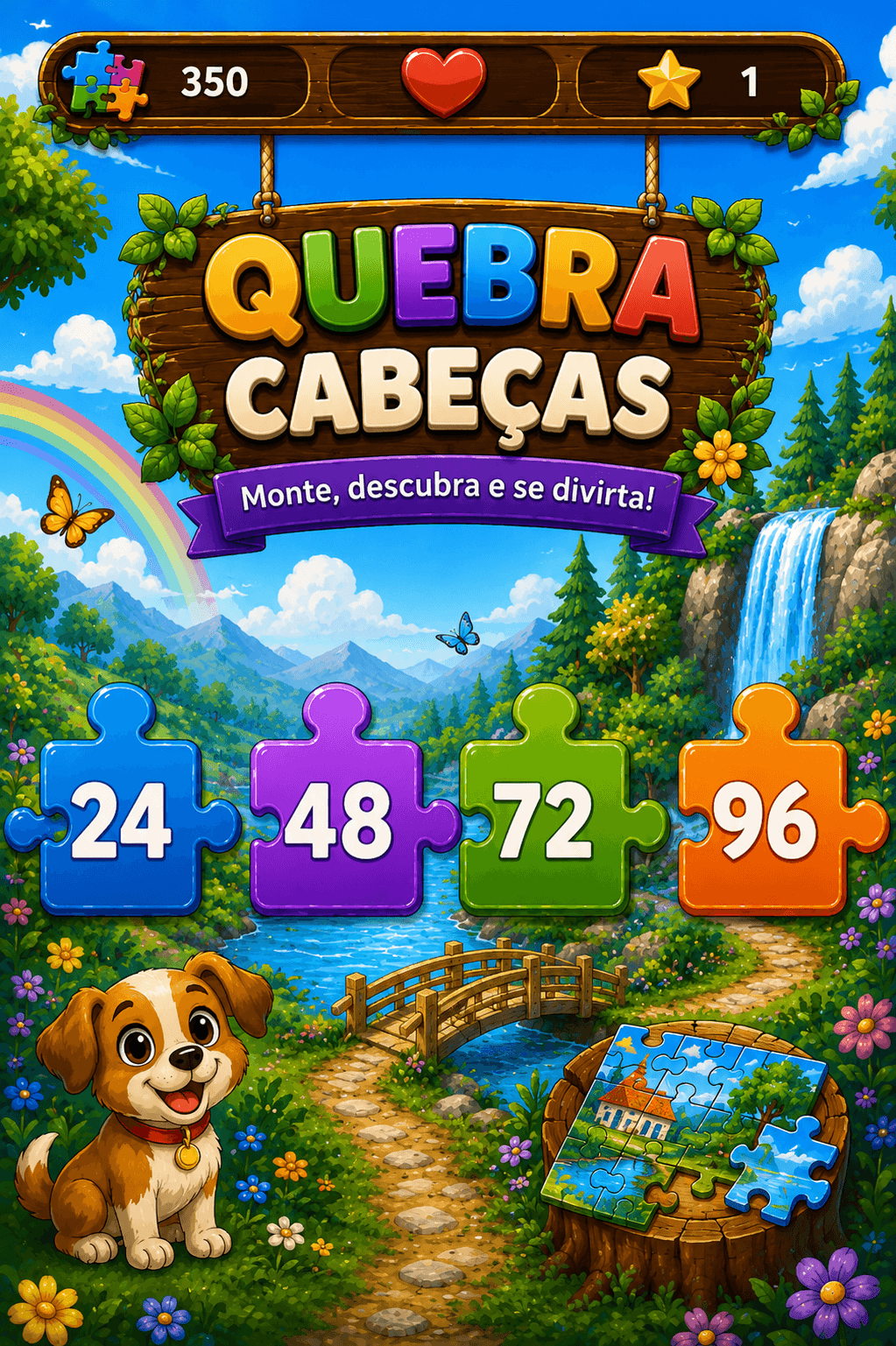
Jigsaw Puzzle is a game where you drag pieces from the piece panel onto the board. Before you start, you choose one of 12 available images and the number of pieces: 12 (easy), 24 (medium), 48 (hard), or 72 (very hard).
Each piece shows a fragment of the original image. On the board, empty spaces display a semi-transparent guide indicating which part of the image belongs there. Drag the right piece to the correct slot to place it. The board is organised in a grid — the more pieces, the more columns and rows.
Time varies with the number of pieces (4 min for 12 pieces, 5 min 30 s for 24, 7 min for 48 and 8 min 30 s for 72). Completing the puzzle with time remaining earns a score bonus. When time is running out, you can use an extra time (+2 min) to continue. Extra times are earned by completing puzzles or watching a rewarded ad.
Challenges
The main challenge is spatial perception: identifying which image fragment belongs to which position on the board, especially when pieces share similar colours and patterns. With 72 pieces, the grid has 9 columns and 8 rows — finding the right space for each fragment demands attention and patience.
Time also adds pressure: with more pieces, the temptation to drag any piece to any slot increases, but wrong placements are rejected by the board, wasting precious seconds. Images with uniform backgrounds (sky, ocean) are the hardest, as fragments look very alike.
Tips to Win
- 1Start with the borders and corners of the image — they are the fragments with the most distinct details and the easiest to identify.
- 2Use the semi-transparent guide on the board as a reference: compare the tone and pattern of the fragment before dragging.
- 3With many pieces in the panel, look for the dominant colour that matches the empty slot on the board.
- 4Assemble the parts of the image with the most contrast or vivid colours first — they are easier to spot than uniform backgrounds.
- 5For the 48 and 72 piece modes, mentally divide the board into quadrants and focus on one quadrant at a time.