History
Every story has an order — a beginning that plants the seed, a middle that nurtures it, and an end that reaps the harvest. But what if that order were scrambled? Could you reconstruct the narrative and restore meaning to the story?
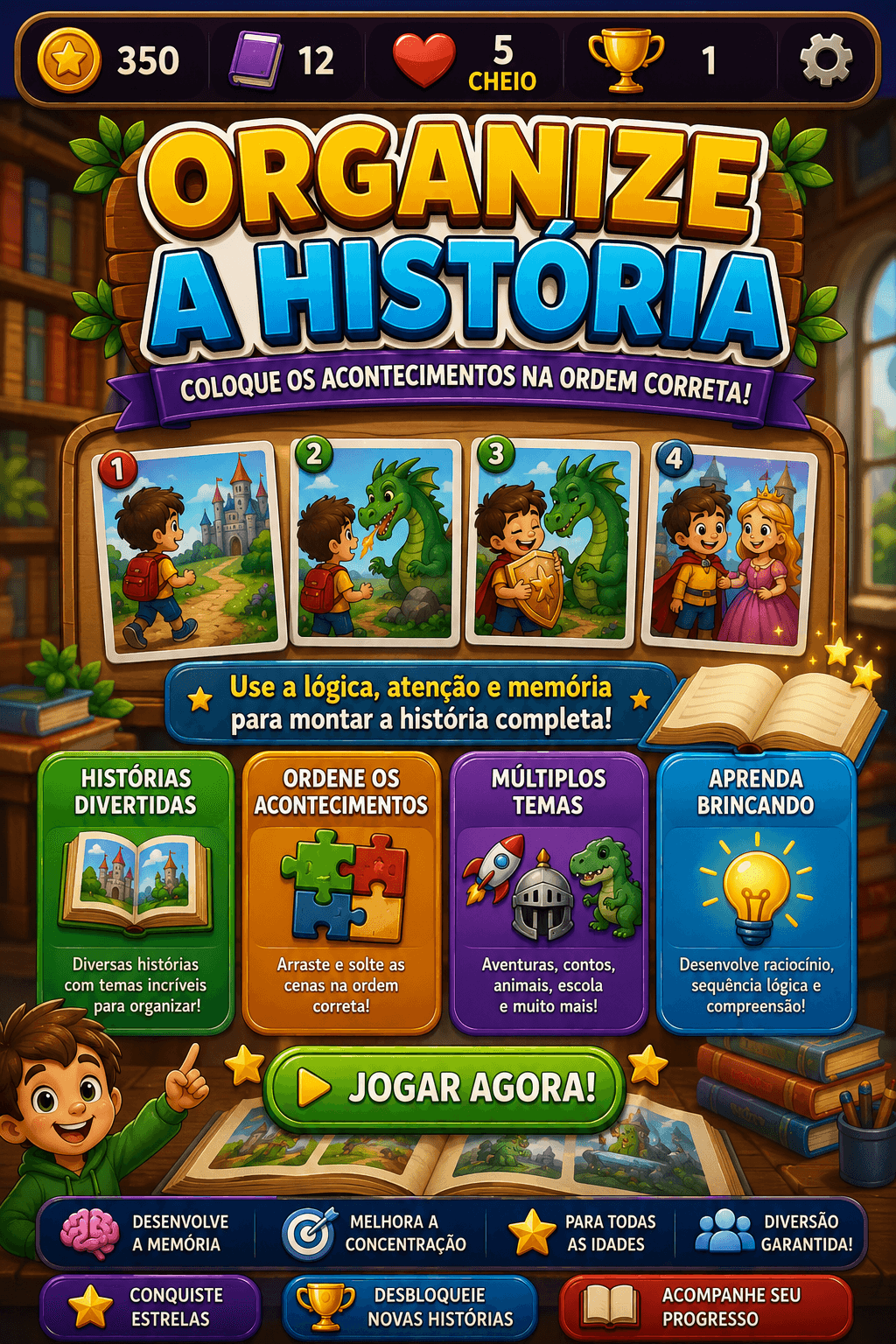
Story Organizer is a narrative reasoning game where you read fragments of real stories and put them back in the correct order. From everyday tales to scientific discoveries and Brazilian historical events, each narrative is a word puzzle waiting to be solved.
Mechanics
The goal is to read the paragraphs of a shuffled story and drag them into the correct logical sequence. When all fragments are in the right order, the complete story is displayed — and a comprehension question may be asked to test whether you understood what you read.
The game has four modes: By Category (you choose the theme — nature, animals, family, science, history, daily life, literature), Random (stories from all categories mixed together), Daily (a new different story every day), and Challenge (against the clock with a ranking).
There are three difficulty levels: on Easy, stories have 3 to 4 simple paragraphs; on Medium, 5 to 6 fragments with more elaborate narratives; on Hard, 7 or more parts with twists and details that require careful reading. An XP system tracks progress with unlockable achievements.
Challenges
The greatest challenge is distinguishing paragraphs that seem to fit in multiple positions — time, cause, and consequence connectors sometimes work in more than one order, making careful reading essential. Stories with multiple characters or interleaved timelines require special attention to pronoun references ("he", "she", "they") to avoid mixing up who does what.
In Challenge mode, the timer adds pressure: reading fast enough to keep up the pace without losing narrative details is the skill that separates average scores from the highest. Hard-level stories with 7+ fragments test working memory at the same time as text comprehension.
Tips to Win
- 1Look for the introduction paragraph first — it almost always presents the setting, the main character, or the initial problem.
- 2The final paragraph usually has conclusion markers: "so", "finally", "in the end", or a resolution of the conflict introduced at the beginning.
- 3Time connectors like "then", "next", "the following day" are valuable clues about a fragment's position in the sequence.
- 4If two paragraphs seem interchangeable, re-read the one before them: there is usually a direct reference that forces the order.
- 5In Challenge mode, read all fragments before starting to order them — getting an overview of the story before moving pieces saves wrong attempts.