History
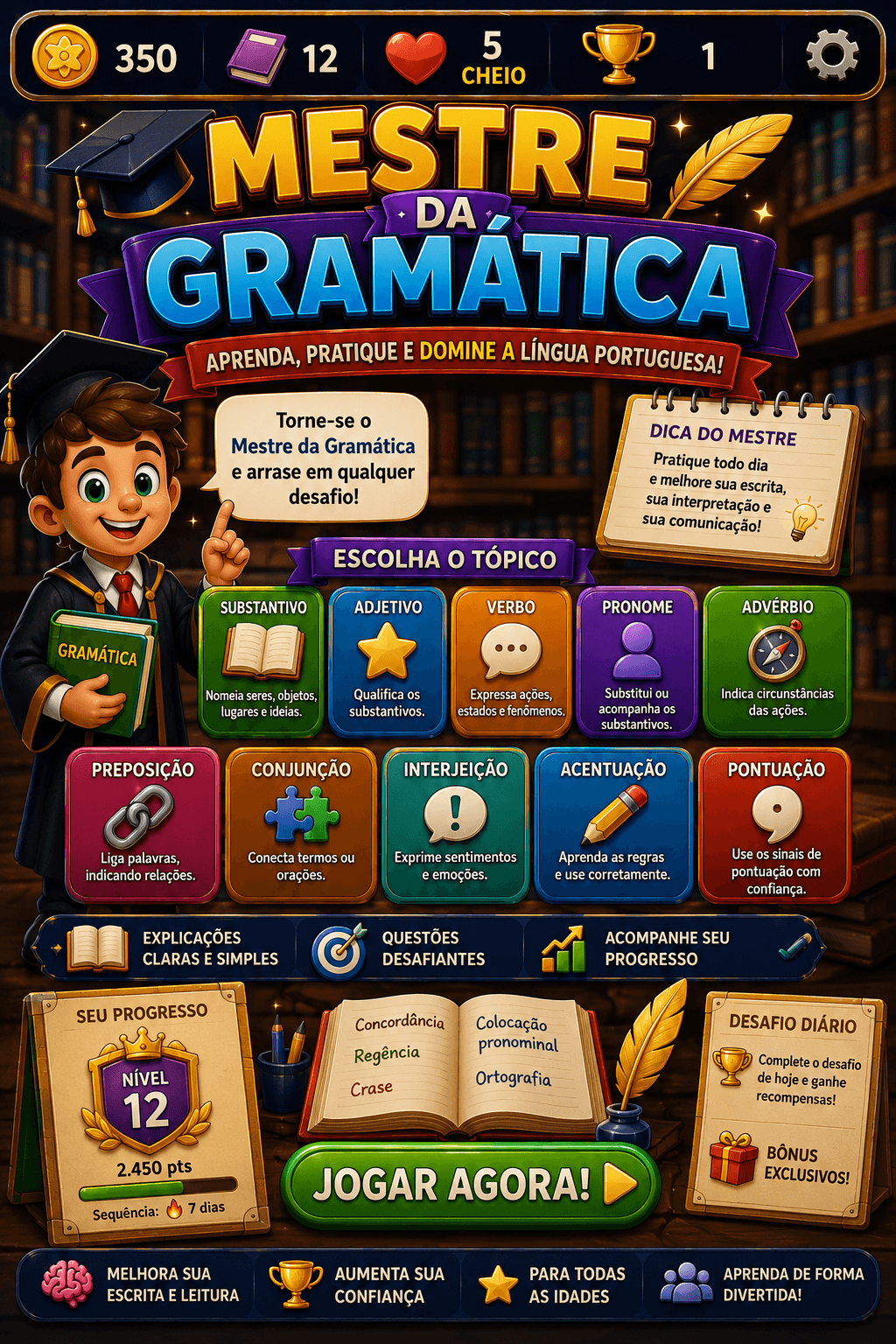
The Portuguese Language Tower has its seven rooms locked — Word Classes, Spelling, Accentuation, Punctuation, Agreement, the Crase rule, and Verbs — each one guarded by a puzzle that only someone who truly masters the language can solve. Without the right keys, not a single sentence in the tower makes sense.
You've been recruited as the new linguistics apprentice to open room after room, phase after phase, proving you have mastered every rule of the Portuguese language. Every phase cleared without mistakes leaves the tower a little brighter — and you a little closer to becoming the Grammar Master.
Mechanics
Grammar Master is organized into 7 themed categories: Word Classes, Spelling, Accentuation, Punctuation, Agreement, the Crase rule (correct, required, and forbidden uses) and Verbs. Each category is split into progressive phases of multiple-choice questions.
Answer correctly to advance through the phase — a wrong answer breaks your streak but doesn't end the game. Completing a phase with zero mistakes earns the "Perfect Phase" bonus. Correct answers add up to XP, which raises your overall level, and the game has its own achievement system, like "Spelling Master" (15 correct spelling answers), "Comma King" (10 correct punctuation answers) and "No Mistakes" (3 perfect phases).
Challenges
The biggest challenge lies in rules with exceptions inside exceptions — like the crase rule before place names, or the difference between the Portuguese "mal" and "mau" (both roughly "bad/badly," but grammatically different), which changes depending on whether the word sits near a verb or a noun. Spelling and Accentuation require memorizing cases that break from the general rule.
Keeping a phase perfect (with no mistakes at all) gets harder in the Agreement and Punctuation categories, where longer sentences hide details that are easy to miss on a quick read.
Tips to Win
- 1Read the whole sentence before answering — many agreement and crase traps only show up when you look at the full sentence, not just the highlighted part.
- 2When unsure about the crase rule, try replacing the feminine word with an equivalent masculine one: if 'to the' fits, the crase is required; if just 'the' fits, it isn't.
- 3To tell apart 'mal' (adverb, near a verb) and 'mau' (adjective, near a noun), mentally swap them for 'well' and 'good' — if 'well' fits, use 'mal'; if 'good' fits, use 'mau'.
- 4Follow the category order: Word Classes and Verbs form the foundation that makes Agreement and the Crase rule easier to understand later on.
- 5To lock in the Perfect Phase bonus, don't rush the first few questions — the bonus is worth more than speed, and a single mistake already costs you the chance.