History
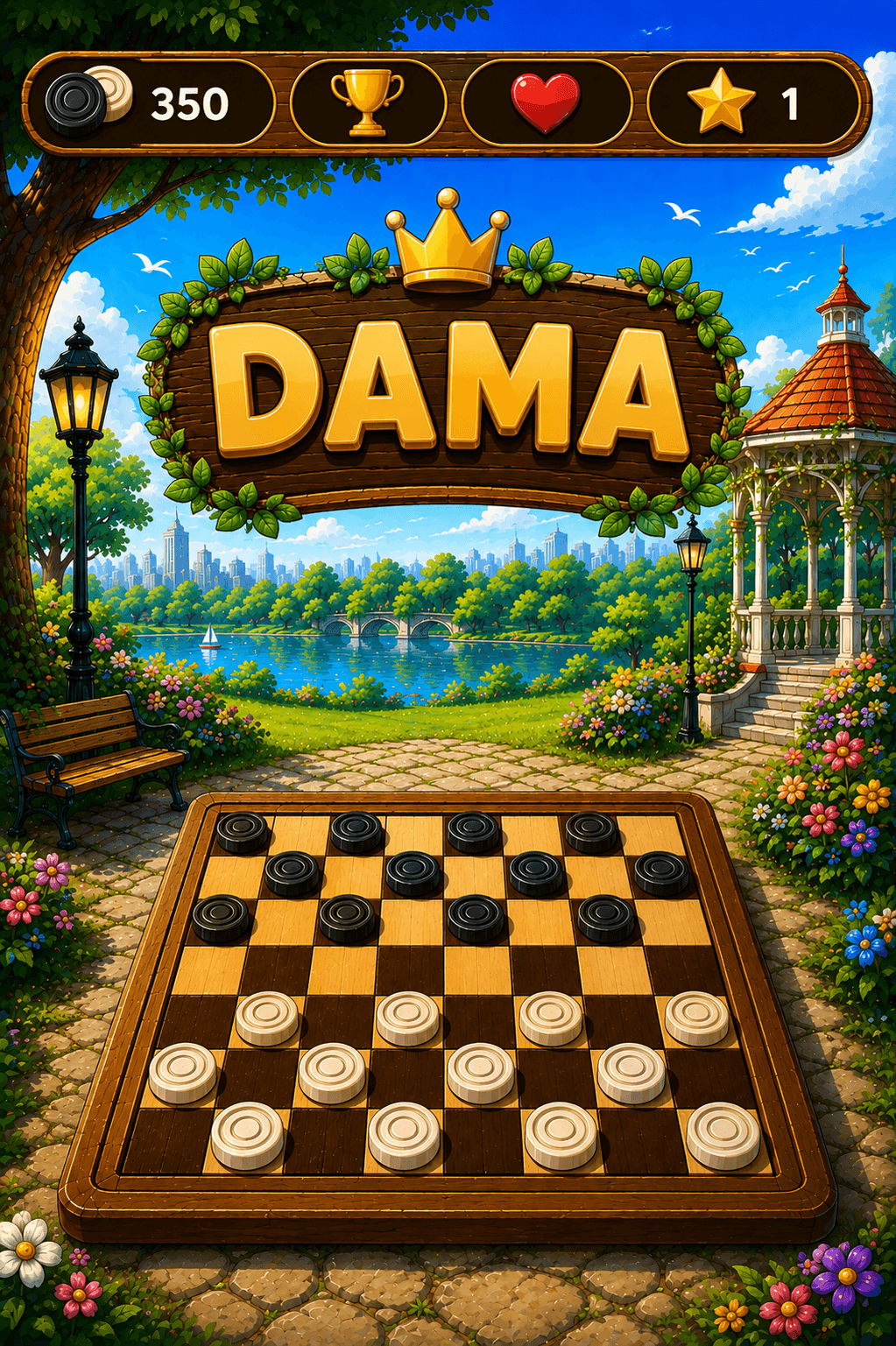
Checkers is one of the oldest and most popular board games in Brazil. Played on an 8×8 board with two-colored pieces, it challenges players to think several moves ahead — like an accessible version of chess for all ages. The Brazilian version has its own rules that set it apart from European variants: regular pieces capture in all directions and queens can fly across the board any diagonal distance.
In this game, you challenge an Artificial Intelligence trained to play like a real opponent. Each match is a battle of strategy, where every move can open an opportunity or create a vulnerability. The challenge begins from the very first moves and grows as the AI adapts to your choices.
Mechanics
The game is played on an 8×8 board using only the dark squares. Each player starts with 12 pieces on their first three rows. You control the white pieces and the AI controls the dark ones.
Brazilian rules:
— Regular pieces move diagonally forward. Upon reaching the last row on the opponent's side, they become Queens (♛).
— Regular pieces capture in all directions — including backward — jumping over the opponent's piece to the empty square beyond.
— Capturing is mandatory: if a capture is available, you must make it.
— Maximum capture is mandatory: if multiple capture sequences exist, you must choose the one that eliminates the most pieces.
— Queens move diagonally any number of squares and capture at any distance.
The game offers three difficulty levels: Easy (AI looks 2 moves ahead), Medium (4 moves) and Hard (6 moves). The match ends when a player captures all the opponent's pieces or leaves them with no valid moves.
Challenges
The greatest challenge in Checkers is thinking several moves ahead. Every piece placement creates simultaneous opportunities and risks — a poorly placed piece can be captured in a chain, eliminating two or three of your pieces at once.
In Hard mode, the AI evaluates 6 levels of depth before each move, making it extremely difficult to beat without consistent planning. Another obstacle is not losing pieces unnecessarily: numerical balance is key — even a single-piece advantage can be enough to decide the match in the final stages.
Tips to Win
- 1Control the center of the board: pieces on central squares have more mobility and more capture options.
- 2Do not advance unprotected pieces — isolated pieces are easy targets for AI chain captures.
- 3Promote pieces to Queens as quickly as possible: the difference in mobility is enormous and can turn the match around.
- 4When capturing, choose the sequence that best positions your pieces afterward — do not just capture for the highest count.
- 5On Hard difficulty, observe the AI's pattern: it tends to protect its Queens and consistently advance along one side of the board.