About the Game
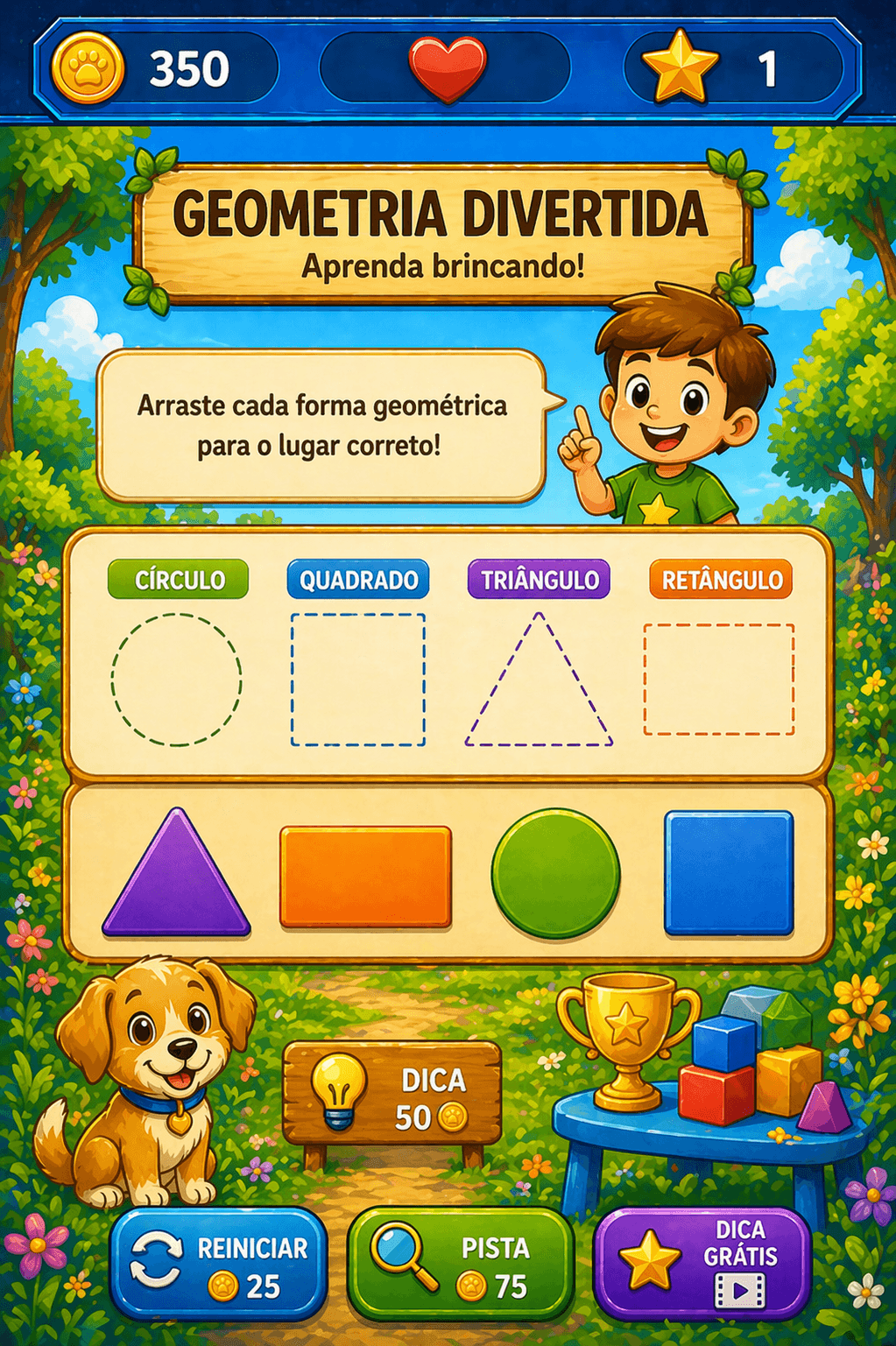
Explore geometric shapes in a playful way! Learn about triangles, circles, squares and more.
Educational Benefits
- 1Recognizes and names geometric shapes
- 2Learns properties of flat figures
- 3Develops visual mathematical reasoning
- 4Aligned with school mathematics curriculum
How to Play
Fun Geometry is a drag-and-drop shapes game. Each round presents target zones and pieces you must place in the correct spots before time runs out. The game has three content levels: — Level 1 (Shapes): drag coloured shapes (circle, triangle, square, rectangle, pentagon, hexagon, rhombus and trapezoid) onto the matching dotted outlines. — Level 2 (Properties): drag cards with property descriptions (sides, angles) to the correct geometric shape. — Level 3 (Calculations): drag the correct area or perimeter answer to the geometric problem shown. The number of items per round starts at 3 and grows to 10 as you progress. You have 3 lives — letting the clock run out costs one life. Levels 1 and 2 have 30 rounds each; Level 3 is endless.
Tips & Strategy
- 1In Level 1, study the dotted outline carefully before dragging — each silhouette is unique and does not repeat.
- 2Start with the shapes you recognise immediately to clear visual clutter and earn quick points.
- 3In Level 2, use keywords like "4 equal sides" (square), "no right angle" (rhombus) and "1 parallel pair" (trapezoid) as identification shortcuts.
- 4In Level 3, memorise the essential formulas: Square area = side², Rectangle area = base × height, Triangle area = (base × height) ÷ 2.
- 5When a round has 7 or more items, prioritise the simplest pieces first — this reduces visual clutter and makes the remaining placements easier.
Frequently Asked Questions
Which shapes appear in the game?▾
Circle, triangle, square, rectangle, pentagon, hexagon, rhombus and trapezoid.
Is the game useful for geometry tests?▾
Yes, it is excellent for reinforcing flat geometry content from the school curriculum.
How do the difficulty levels work?▾
Early levels have simple shapes; advanced levels include rotations and size variations.
Does the game explain the shapes?▾
Yes, when you answer, an important characteristic of the geometric shape is displayed.