History
The JCS Space Station just got an alert: the map of the Solar System went missing from the archives, and nobody remembers the correct order of the planets, their fun facts, or their secrets anymore. To rebuild the map, Mission Control needs an explorer willing to visit all eight planets, one by one, gathering data and completing the challenges of each mission.
You've been chosen as the new Exploration Commander. Your 3D spaceship is ready to launch toward Mercury, Venus, Earth, Mars, Jupiter, Saturn, Uranus, and Neptune — and every fun fact discovered along the way brings humanity one step closer to rebuilding the complete map of the Milky Way.
Mechanics
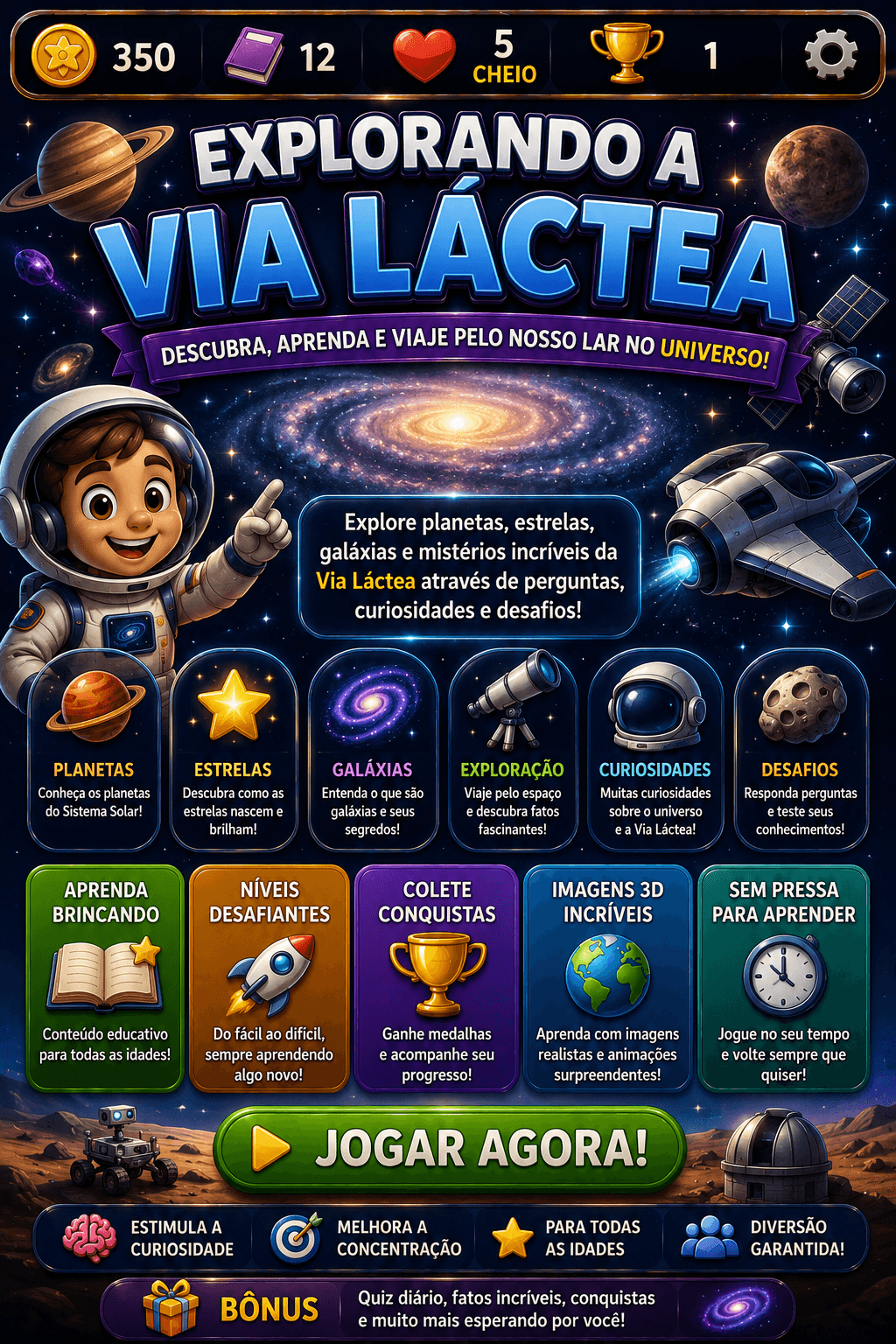
Exploring the Milky Way is a 3D journey through the 8 planets of the Solar System. When you visit each planet, you can rotate and examine the model, read its description, and uncover hidden fun facts — each fun fact discovered earns +5 XP.
Every planet has its own mission: a quiz with questions about its characteristics (size, distance from the Sun, temperature, moons, gravity, and more). Completing a planet's mission adds to your overall progress (missions completed out of 8) and unlocks special achievements, like "Mars Specialist" (complete the Mars mission with no mistakes), "Planet Master" (complete the mission for all 8 planets), and "Curiosity Hunter" (discover every fun fact in the game). The game also has daily missions that refresh every day.
Challenges
The biggest challenge lies in questions about less familiar planets, like Uranus and Neptune, whose characteristics (axial tilt, atmosphere composition, number of moons) are less widely known than Earth's or Mars's. Getting a planet's mission perfect, which is required for achievements like "Mars Specialist," demands full attention to the descriptions before answering.
Finding every hidden fun fact across all the planets is also an exploration challenge in itself — it's easy to rush ahead to the next mission without stopping to explore every corner of the current planet.
Tips to Win
- 1Before attempting a planet's mission, explore the 3D model thoroughly and read the full description — several quiz answers come straight from there.
- 2Prioritize discovering all the fun facts on a planet before leaving it — you can come back later, but it costs more exploration time.
- 3For 'Mars Specialist' and similar achievements, mentally review the mission before answering: think of the answer before looking at the options.
- 4Keep an eye on the daily missions — they're an extra source of XP that refreshes every day, even after you've visited every planet.
- 5Gas planets (Jupiter, Saturn, Uranus, Neptune) tend to have questions about atmosphere composition and moons — rocky planets (Mercury, Venus, Earth, Mars) focus more on surface, temperature, and distance from the Sun.